

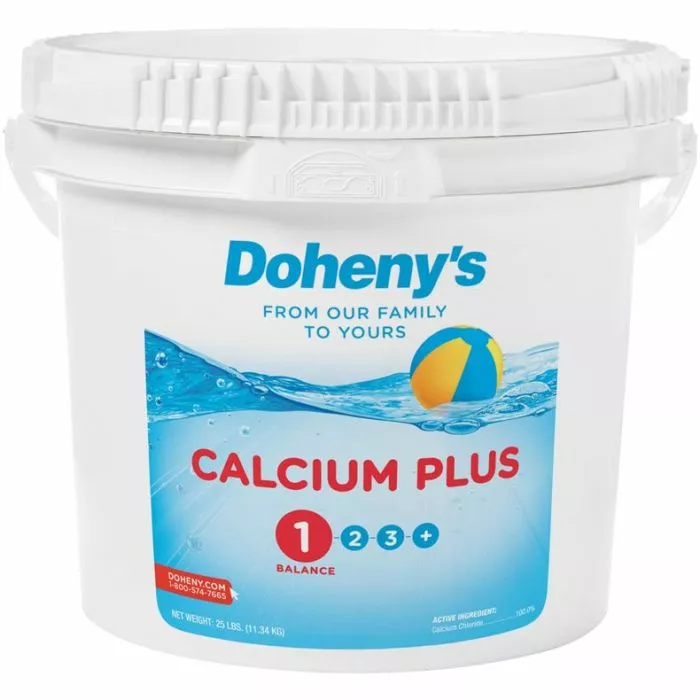
Calcium Plus raises calcium hardness to prevent staining and corrosion. Low hardness levels can result in corrosion of pool surfaces and fixtures. When water hardness levels drop below 150 ppm, you need to add Calcium Plus. Calcium Plus will instantly raise calcium hardness in your pool water.
Doheny's Calcium Plus, 25 lb
Sale
$56.69
$62.99
Sale
$2.26/lb
Sale
$56.69
$62.99
Sale
$2.26/lb
In stock
- Brand
- Doheny's
- MPN
- 12000087
- SKU
- 4843
Item 4842P
Sale
$56.69
$62.99
Sale
Instant Purchase Confirmation
Shipping Address:
Billing Address:
Payment Method:
Shipping Method:
Loading...
Product Overview
- Made in the USA!
- Instantly raise calcium hardness in your pool water.
- Contains granular calcium chloride.
- Add when hardness levels fall below 150 ppm to prevent staining and corrosion.
- Dosage: 6 lb per 10,000 gallons to raise ppm by 50.
- Chlid-resistant bucket.
Product Description
Balance Your pH Levels With Ease - Balancing your pool's pH levels has never been easier with Doheny's pH Plus, pH Minus, and Alkalinity Up! Keep your pH level between 7.2 and 7.6 ppm. Staying within that range will keep you and your pool equipment safe. On top of that, having a balanced pool will prevent scaling or cloudy water. Remember, always adjust your Alkalinity levels before adjusting your pH levels. Alkalinity acts as a buffer for your pH levels. If your Alkalinity levels are out of balance, you will never be able to get your pH properly adjusted because it will never “lock in”. By making sure that your Alkalinity level is at 80-120 PPM first, then balancing your pH, it will be more stable and less susceptible to “pH drift”. pH drift occurs when your Alkalinity is out of balance and it causes your pH level to fluctuate wildly depending on bather loads and rain.
Stabilize Your Calcium Hardness Levels - Prevent stains and corrosion with Doheny's Calcium Plus and Calcium Reducer! Our strong solutions are built to act fast and work hard so you don't have to. Don't allow your Calcium Hardness levels to fall below 200 ppm. For plaster pools, maintain a range of 225-300 ppm and for vinyl, fiberglass, and non-masonry pools maintain a range of 175-225 ppm. If you are using well water in your swimming pool, a properly balanced calcium hardness level is a must!
Increase Your Chlorine Effectiveness - Make your chlorine work more efficiently with Doheny's Stabilizer! Using our stabilizer protects your chlorine from the sun's UV rays, making your chlorine last much longer. Chlorine levels too high? Not a problem! Use Doheny's Chlorine Neutralizer to quickly lower your chlorine level to a safe range.
Compare Products
Specifications
Directions for Use
1. Measure water for hardness (calcium level) using a suitable test kit.
2. From the chart below, determine the quantity of Calcium Plus required based on results of measured values in step 1. above and capacity of pool. As a general rule, 6 pounds of Calcium Plus per 10,000 gallons of pool water will raise the hardness (calcium) level by 50 ppm. For plaster pools, ideal hardness levels should be maintained between 225 - 300 ppm. For vinyl, fiberglass, and non-masonry pools, ideal hardness levels should be maintained between 175 - 225 ppm.
3. Add Calcium Plus directly to the pool water by scattering over a large area. Make certain that the circulation equipment (filter pump) is operating. DO NOT PREDISSOLVE IN A BUCKET OR ADD TO A SMALL QUANTITY OF WATER. Heat is generated when this product is dissolved in water.

NOTE: If soda ash or sodium bicarbonate has recently been added to pool water (within 24 hours), it is best not to add this product until the next day. An insoluble precipitate is likely to form resulting in cloudy pool water.
Pool Capacity Pounds Required to Raise Calcium Hardness
| (Gallons) | 10 ppm | 30 ppm | 50 ppm | 100 ppm | 150 ppm | 200 ppm |
|---|---|---|---|---|---|---|
| 10,000 | 1.25 | 3.75 | 6.25 | 12.5 | 19 | 25 |
| 15,000 | 1.75 | 5.5 | 9.5 | 18 | 29 | 36 |
| 20,000 | 2.5 | 7.5 | 12.5 | 25 | 38 | 50 |
| 25,000 | 3.25 | 10 | 16 | 32 | 48 | 64 |
| 30,000 | 3.5 | 11 | 19 | 36 | 58 | 72 |
| 40,000 | 5 | 15 | 25 | 50 | 72 | 100 |
| 50,000 | 6.25 | 19 | 32 | 64 | 96 | 128 |
General Information
Low calcium hardness in your pool can result in staining, etching or distortion of the pool's surface. Plaster damaged by low calcium hardness can become abrasive and uncomfortable to pool users. Rough plaster can also increase algae problems, thus causing greater difficulty in keeping the plaster surface clean. This can be prevented by using Calcium Plus. The calcium hardness level should be maintained in the range of 225 - 300 ppm for plaster pools (175 - 225 for vinyl, fiberglass, and non-masonry pools). DO NOT allow the calcium hardness level to fall below 200 ppm for plaster pools.
Storage and Disposal
Store closed container in a cool, dry, and well-ventilated space. When container is empty, rinse thoroughly with water, wrap securely in newspaper, and place in trash collection.


